



The Specter of Sovereignty: Populism, Antisemitism, and the New Class
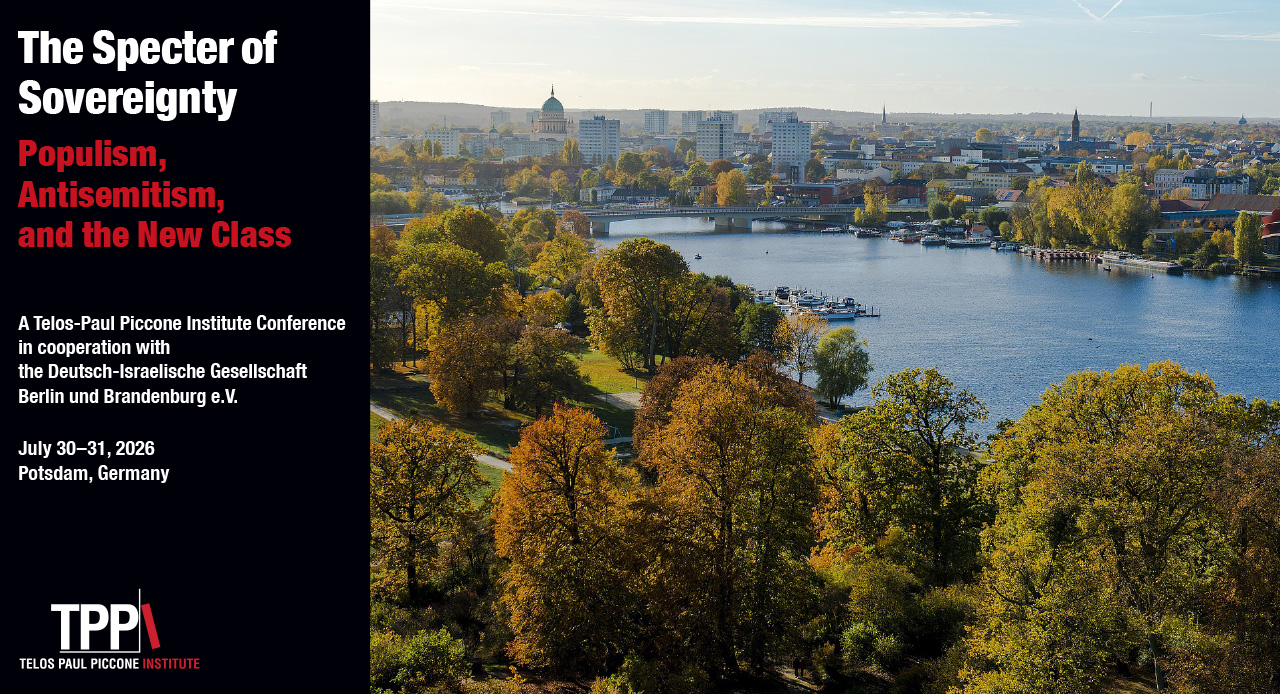
A Telos-Paul Piccone Institute Conference in cooperation with the Deutsch-Israelische Gesellschaft Berlin und Brandenburg e.V.
July 30–31, 2026
Potsdam, Germany
About the Conference
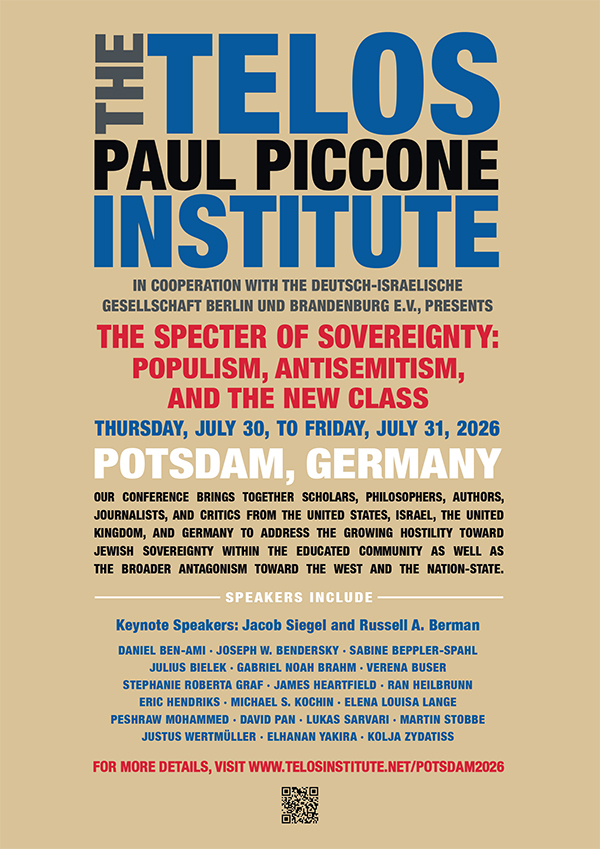
Our conference will bring together more than thirty scholars, philosophers, authors, journalists, and critics from the United States, Israel, the United Kingdom, and Germany. Together, we will address the growing hostility toward Jewish sovereignty within the educated community. This hostility is accompanied by a broader antagonism toward the West and the nation-state. These developments demand scrutiny.
Presenters will include Elhanan Yakira, Joseph Bendersky, Daniel Ben-Ami, and Justus Wertmüller. Our goal is to combine rigorous philosophical inquiry into the nature of sovereignty with the incisive critiques of editors and writers from Telos, Britain’s Spiked, the German Bahamas magazine, the Freiblickinstitut, and the recently founded casa |blanca magazine.
We are also pleased to announce that Tablet Magazine’s Jacob Siegel, who has strong ties to the Telos community, and our own Russell A. Berman will be our keynote speakers.
Conference Description
 After the pogrom of October 7, 2023, antisemitism in the West has—ironically, tellingly—resurged on both the left and the right, while retaining its long-standing prominence within Islamic communities. At the same time, as transnational institutions seek to undermine the sovereignty of the world’s only Jewish state, most visibly through the United Nations, Islamic counter-sovereigns have emerged across Europe, particularly in its major cities, amid the broader erosion of national sovereignty.
The New Class (sometimes used synonymously with Professional-Managerial Class)—theorized by Djilas, Burnham, Galbraith, Bell, Moynihan, Ehrenreich, and many others—overflows with members who support, excuse, relativize, or willfully ignore the rise of antisemitism and Islamic terrorism. Indeed, this may be one of its structural characteristics as a historical phenomenon. Without the backing of postcolonial studies and its left-wing adherents, for instance, the gradual establishment of Islamic counter-sovereigns in Europe’s cities would hardly be conceivable. Moreover, the New Class promotes all manner of expert rule, curtailing both individual freedom and community self-determination in the name of “science” and “humanity,” while dismissing the needs and worries of ordinary people.
In Europe and America, the New Class has sparked a populist backlash that seeks to reestablish the Western principle of national and popular sovereignty. Yet the backlash also comes with its own set of urgent political and theoretical challenges. Populism takes many forms—conservative, reactionary, and socialist—and whether any of these forms offers a solution to our political condition is open to question. In the West, antisemitism is endemic in left-wing populism, but there are also deep antisemitic tendencies within right-wing populism that need to be addressed.
Topics of Discussion
Pressures on National Sovereignty: National sovereignty today is under pressure from Islamism, jihadism, mass migration, and supranational institutions. How should we understand these pressures? What are the implications of digital sovereignty, border control, and Germany’s and Europe’s military dependency?
Political Economy: What are the economic structures behind the West’s political and cultural disintegration? Topics include strategies of class conflict, the tension between economic and political primacy, and the specific features of the German, European, and American New Class/PMC. What is the relation between the New Class and the “Old Class”?
Populism and the Public Sphere: How do populist mobilizations arise in the context of the perceived or actual exclusion of social groups? What role do elites, NGOs, and other actors who shape the public sphere institutionally or communicatively play in this? How is the current restructuring of political communication, driven by social media, changing traditional gatekeeping mechanisms, and what consequences does this have for the democratic public sphere?
Bad Actors at the University: How do foreign influence, postcolonial ideology, antisemitism, and political pressures toward conformity within academic institutions shape contemporary understandings of sovereignty?
AI and Social Media: How do technological monopolies, algorithmic control, and digital censorship shape public discourse on national sovereignty?
The Attack on Israel’s Sovereignty: How should we understand the erosion of Israel’s sovereign agency through global political and legal mechanisms, including the use of lawfare?
Idealism vs. Realism in Global Conflicts: How should we view a range of concrete geopolitical conflicts—Israel/Palestine, Ukraine/Russia, and the United States/China—in relation to the foreign policy paradigms that shape national interests and the available strategic responses?
President Trump: Prospects and Dangers: How have President Trump and his circle reframed debates over sovereignty, institutional authority, and populism, and how should we assess the Trump administration’s impact on the reordering of the West?
Globalization and National Security: How do Islamic terrorism, mass migration, and open-border ideologies challenge the internal security of Western states?
Political-Philosophical Concepts of Sovereignty: How did early modern political thought shape the modern concept of sovereignty? Which political and theological assumptions from the traditions of Bodin, Hobbes, and Schmitt continue to resonate today? And where do the main fault lines lie among competing theories of the state and political authority, including liberal, conservative, and revolutionary approaches?
In addition to the prospect of a fruitful discussion, the conference’s ultimate goal is to foster intellectual friendships that could lead to future collaborations, even across lines of potentially deep disagreement. In that spirit, we will feature contributions from all kinds of theoretical approaches or polemical interventions in what we expect to be a stimulating exchange between intellectual communities.