




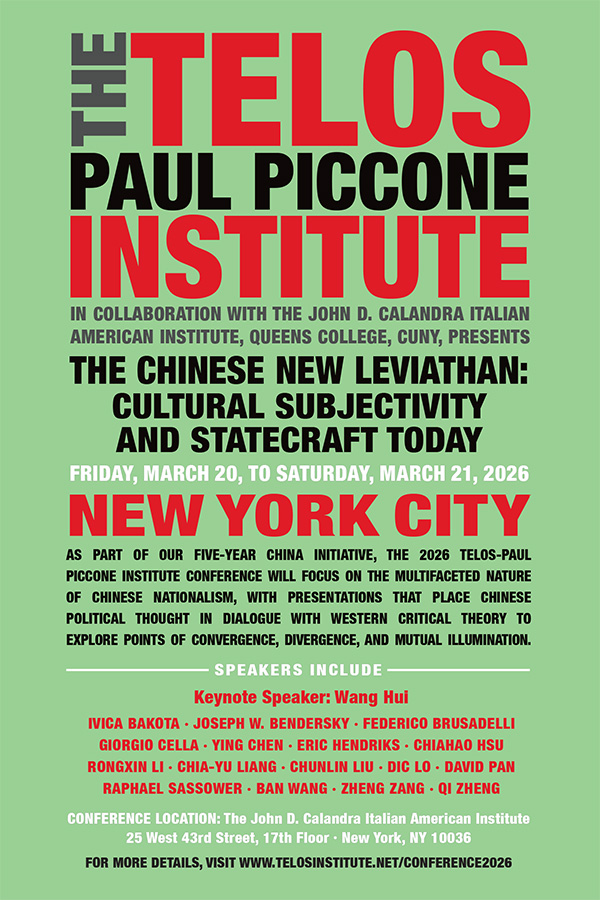
The Telos-Paul Piccone Institute Annual Conference
March 20–21, 2026
The John D. Calandra Italian American Institute, Queens College, CUNY
25 West 43rd Street, 17th Floor
New York, NY 10036
The Chinese New Leviathan: Cultural Subjectivity and Statecraft Today
Co-sponsored by the John D. Calandra Italian American Institute, Queens College, CUNY
Keynote Speaker: Wang Hui (汪晖)
Renowned as a critical theorist and one of China’s leading intellectual historians, Wang Hui (Tsinghua University) will speak on the nexus of state, nation, and empire in modern Chinese history, and its implications for our understanding of modernity as such. His keynote address is entitled “China Under the Condition of Spatial Revolution at the Dawn of the Pacific Era.”
Conference Description
 Following the fruitful discussion that took place during our “China Keywords” conference in March 2025, our 2026 annual conference will focus on “The Chinese New Leviathan: Cultural Subjectivity and Statecraft Today.” The conference is part of TPPI’s five-year China Initiative, which aims to foster a critical and mutually regarding discussion of social and political theory between China and the West, well beyond the circles of China specialists. This outreach effort across political boundaries continues a tradition established by the journal Telos, which played a pivotal role in fostering a reciprocal encounter between intellectuals in the Anglosphere and Eastern Europe during the Cold War. Essays from the “China Keywords” conference will appear in two special issues of the journal, beginning with Telos 213 (Winter 2025).
As one of the most potent and complex keywords in modern China, nationalism demands our rigorous theoretical engagement. It functions as a source of state legitimacy, a tool of social mobilization, and a site of intense public debate. From official state proclamations of rejuvenation to the pulse of online crowds, nationalism flows through China’s internal politics and its global stance. Its conceptualization has provided the intellectual context for the development of modern Chinese power, and it therefore needs to be understood both on endogenous terms and from a global philosophical perspective.
Under General Secretary Xi Jinping, Chinese civilizationalist discourse has surged. This discourse blends traditional Chinese thought with party ideology, positioning the PRC as a civilizational state and depicting international politics as an interplay of civilizations. While some critics warn that civilizationalist discourse establishes an imperialist form of nationalism, essentializes “Chinese characteristics” (the official phrase: “Socialism with Chinese Characteristics”), and entrenches a rigid, even antagonistic, East-West divide, others take a more optimistic view. As Jin Huimin of Sichuan University observed in his keynote at our 2025 China conference, an unreflective call for cultural self-confidence can indeed devolve into a closed-door cultural nationalism that polemicizes against Western cultures. Yet if we recognize that cultural subjectivity can encompass “learning from and absorbing all the outstanding achievements of human civilizations, then it in turn can enrich an open-minded cultural self.”
Prof. Jin’s proposal echoes R. G. Collingwood’s The New Leviathan (1942) in advancing a more open-ended conception of a civilizational state. It is partly with Collingwood’s ideas in mind that TPPI issues this call for papers. Are we witnessing in China the emergence of a full-fledged alternative nationalist political modernity? Is the world indeed entering the mysterious New Era prophesied by some Chinese political thinkers? Or will the consequences of the CPC’s effort to refigure the meaning of nationhood, as one critique would have it, be authoritarian repression buttressed with new conceptual tools—and in the West as much as in China? If the latter, then in light of Collingwood’s and related philosophical perspectives, what might be a promising path forward?
Conference presentations will move beyond descriptive accounts to theorize the multifaceted nature of Chinese nationalism. We are particularly interested placing Chinese political thought in dialogue with Western critical theory, exploring points of convergence, divergence, and mutual illumination. While some speakers and participants in this conference will be China specialists, we warmly encourage non-specialists to become part of our conversation. We also welcome responses from every political and ideological perspective. Indeed, the clash of radically divergent, often unconventional ideas is one of the hallmarks of our conferences.
Topics and guiding questions include, but are not limited to: how the Chinese Communist Party (CCP) cultivates, manages, and deploys nationalist sentiment; the relationship between party ideology and popular nationalism; the defining features of nationalism as expressed on Chinese social media and in popular culture; Chinese nationalism and global order; the interaction between Han nationalism and the identities of ethnic minorities; and the contours of nationalist sentiment in Hong Kong, Taiwan, and the broader Chinese diaspora.
We are particularly interested in critical deconstructions, analyses, and applications of key concepts in contemporary Chinese political thought. Contributors are encouraged to engage these concepts explicitly in their theoretical reflections—not only as entry points into Chinese political thinking, but also as tools for critically examining sociopolitical idealisms, institutions, and power structures in both China and the West. In the context of Chinese nationalism, the following key concepts are of central importance:
- Civilizational State (文明国家)
- National Rejuvenation (民族复兴)
- Patriotic Education Campaign (爱国教育)
- Online Public Opinion Guidance (舆论引导)
- National Unity (民族团结)
- Historical Revisionism (历史修正主义)
- National Pride (民族自信)
- Sovereign Integrity (主权完整)
- Self-Reliance (自力更生)
- Cultural Confidence (文化自信)
- Patriotism (爱国心)
- Theory Confidence (理论自信)
- System Confidence (制度自信)
- Century of Humiliation (百年国耻)
- Chinese Dream (中国梦)
- Chinese-style Modernization (中国式现代化)
Our 2026 conference will be organized by Prof. Chiahao Hsu of Si-Wan College, National Sun Yat-sen University in Taiwan.
Conference Location
The conference will be held at the John D. Calandra Italian American Institute at 25 West 43rd St., 17th Floor, New York, NY 10036. The Calandra Institute is located in midtown Manhattan and is close to major subways stops. It is three blocks from Grand Central Station, two blocks from the Bryant Park subway stop, and three blocks from the Seventh Avenue/42nd Street subway stops. For more information about the Calandra Institute, visit their website at calandrainstitute.org.
For information about the Telos-Paul Piccone Institute’s China initiative, click here.